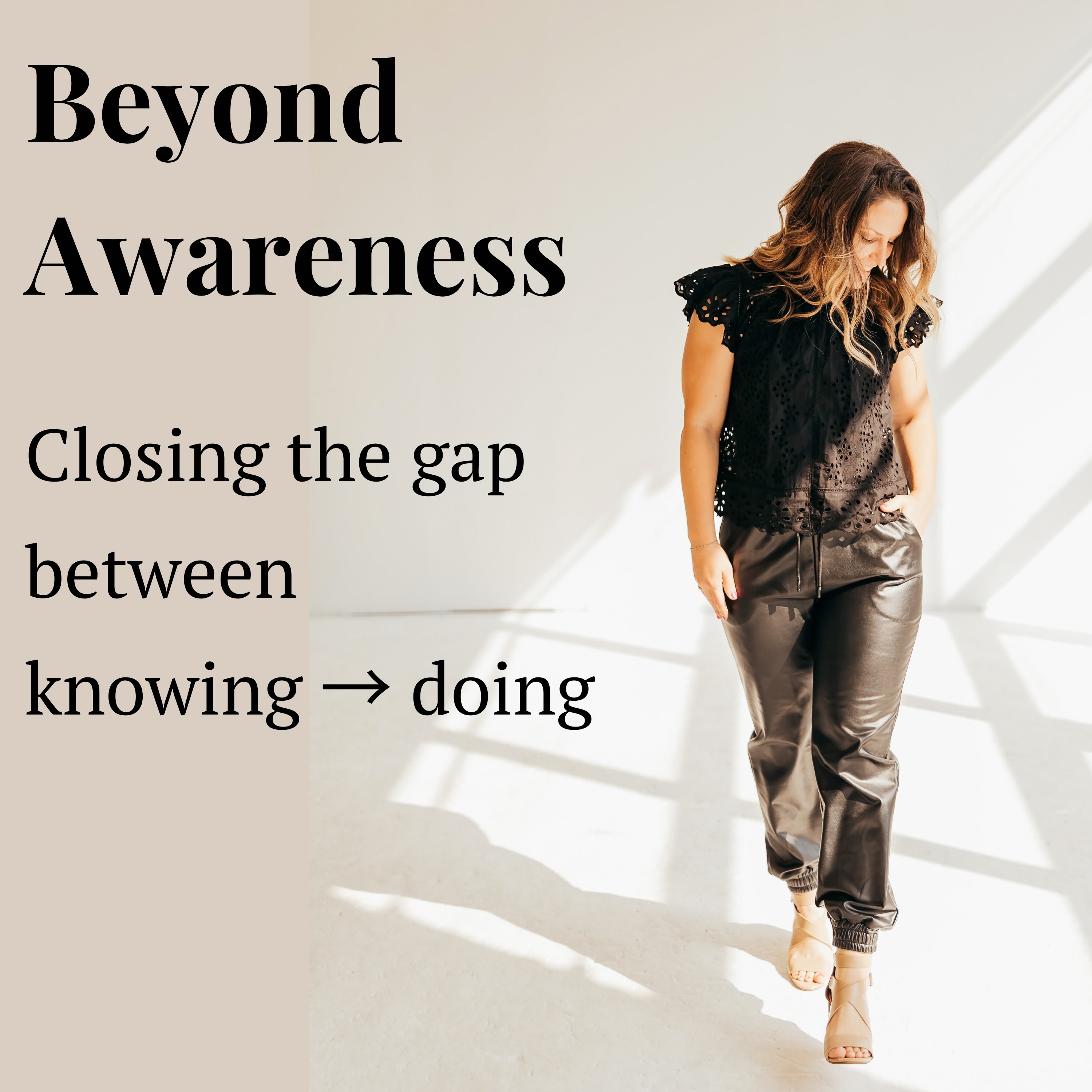
218. From Carrying Everything in Your Head to Finally Letting the Mental Load Go (Part 1)
Your body is exhausted, but your brain won’t stop. You lie down at night and suddenly you’re replaying everything you did today, everything you didn’t do, who you forgot to respond to, what your kids need, and what might fall apart if you stop thinking about it for even a second.
This episode is Part 1 of the Beyond Awareness series, where we look at why knowing what to do isn’t the problem. And why awareness alone hasn’t been enough to create real change.
This isn’t a time-management issue. It’s not a discipline issue. And it’s not something another planner or system will fix.
In this episode, I walk you through:
- Why holding everything in your head feels like responsibility, even when it’s costing you peace
- The hidden beliefs that keep your brain “on” all the time
- Why solutions like time-blocking, hiring help, or organization systems don’t stick
- What actually has to shift for the mental load to get lighter
On Thursday, we’ll continue this work with a strategic journaling episode to help you uncover the specific belief that’s running your mental load, so you’re not just aware of it, but able to release it.
Work with me:
- Breakthrough Intensive - You already know you should slow down, delegate more, stop overcommitting & be emotionally present. So why can't you? That's what we figure out in 90 minutes + integration call 2 weeks later. Book your Breakthrough
- Exhale: Private Coaching - For women ready to do this work until it sticks and you can't revert back. 4 open spots: Work with me
Transcript
Ten.
Samantha Hawley (:Easy.
Samantha Hawley (:you
Samantha Hawley (:Are you like me lately where the second your head hits the pillow at night, it's like your brain gets a second wind. You are lying in bed, maybe it's 9 p.m. on a good night, but like 10 p.m. and your body is tired, but your brain is mentally reviewing what you accomplished today, what you didn't accomplish, and so then your brain puts it on tomorrow's to-do list.
your meetings tomorrow, your kids' appointments tomorrow, whether you remember to respond to certain emails or text messages that day, what's in the fridge for tomorrow's meals, what you ate this current day, and if it was quote unquote proper nutrition or not, if you exercise, should you exercise more.
if your team finished the project or not. Basically, your brain just won't stop running. And then maybe you try to start dreaming a little bit and your brain naturally pulls you back into the no, no, no, but don't forget, you didn't yet think about X, Y, Z, and then it just keeps on going. And you're wondering, or maybe you're just believing and thinking that maybe is this just what being responsible looks like? Like this feeling sucks.
and it's exhausting mentally, but at least all the T's are crossed and the I's are dotted, right? Today, we are talking about why you can't stop holding everything in your head and why that mental load and that mental chatter is so big and heavy and long, that long list. And this is part one of the official three part.
Beyond Awareness series where we are figuring out why you know what to do, but you can't actually do it. I'm so excited for this. This is the series that I had planned before I actually changed the name of this podcast to Beyond Awareness because this is the pattern that I see with literally every woman that I talk to. And when I say pattern, I was thinking about this last night as I was falling asleep and
Samantha Hawley (:pattern to me, it is a behavior that I'm noticing and a thought loop. So next week, we are diving into why you can't delegate. So that's the behavior is like you're not delegating, even though you're drowning and we'll talk about the thought loop behind it. And then in part three, so in two weeks,
or tackling why you keep saying yes even when you want to say no. So that's the behavior and then the thought loop behind it. But today we are starting with the number one thing that I again hear from every single woman. And that's not an exaggeration. This is something that I hear from everyone, which is why I wanted to start off with it. And it's the mental load because not only am I hearing this from everyone, but it's so important. If you can't turn off your brain.
And if you can't reduce the mental load or at least the weight of it, nothing else matters. No matter what you do, no matter where you travel to or what vacation or retreat you go on to escape, you will always feel that heavy weight. And so the way that this is gonna go, today's episode and all Tuesday's episode in this series will be the main topic and I'm gonna give you permission slips.
to begin to release the grip that this pattern has on you. And Thursday's episodes are normally strategic journaling episodes. And so you are going to be given three or four strategic journaling prompts to actually work through that topic. So by the end, you're not going to just be...
Samantha Hawley (:So by the end, you're not just going to be aware of the fact that you've got a lot in your head, that you take on too much, and that you're people pleasing, but you will uncover the root belief or beliefs that have been preventing you from actually changing and actually feeling better. So let's jump on into today's topic, which again, is that you're holding so much in your head. And the thought
loop behind that, what I find is that we do this because we think if we don't, all of the balls will drop. Or what I hear often is, if I don't do it, who will? So it's almost like this responsibility. Like, I have to be the one that thinks of all of these things. So we do. We remember. Again, I don't have to repeat that list. In fact, when I do, I even
my stress starts to increase just thinking of all of the things that go on in our head. So I don't even have to do that. And I think if I even just take a moment to breathe myself and prompt you to think what is in your head right now, you will think of some things, right? Just think about what is going on in your head right now. And I bet you have like five thoughts from different areas of your life.
your personal life, your career, your family, the fact that you maybe should have some hobbies or something about your health or something. So that's not what we're gonna really dive into because that's the no-brainer, of course. That's the problem that you very much are well aware of. And we're going beyond awareness today. The other thing though that I know that you are aware of is since you're aware of this problem or pattern, if you will,
You have tried solutions or you have a list of solutions to try. And what I see is that often we think that it's a time management problem because we have so much on our plate and we think I just have to do more and I'm just not organizing my time in the best way, potentially. And so we try doing time audits to see where your time is going or potentially time blocking.
Samantha Hawley (:Maybe you try different calendar solutions. Another solution that you may have tried or have said that you want to try is hiring. I see this a lot with business owners or just people with authority in their companies hiring more people at work so that they do have the opportunity to delegate and whether or not they do, we're going to talk about next week.
but you hire more people or you hire people at home, maybe a cleaning lady or a nanny to help with the kids at school. So you are acknowledging that there's so much on your plate and you're hiring people or maybe another solution is organization systems. You try lots of different organization systems at home, at school, cleaning up your desk, maybe more meetings with your employees, lots of different solutions here, right?
Here's the thing that is often skipped, which is why those solutions, which those solutions are great solutions. The reason that they don't work at all in the first place or that they don't stick. And what I mean by that, I mean, I think that I don't need to go into more depth there, but the reason that
Hiring more people leaves you still feeling like, my God, I'm still so stressed. Or time blocking works in theory on your calendar, yet when that notification goes off so that you switch to a different task, you're not actually switching to the task. You bleed right into that next task, but you're still on the previous task, right? Or you download that Time Audit app, but you still haven't started doing that time audit because you're afraid.
of what you might find, right? So those are great solutions, but what is often skipped is that even with the organization systems, papers are still piling up on your desk. Laundry still piles up on the living room floor, right? And after this, we're going to get to the beliefs of why that's still happening. But it's just that it's so easy to know what the pain point is, what the problem of that mental chatter.
Samantha Hawley (:and jumping to the solution without recognizing that even with all those planners and apps, you're ignoring the notifications to switch the tasks. And what I specifically found with one of my clients said is that she had a fear of not working right up until the clock when her kids got home because she might disappoint a client or a team member. Her specific goal
was that she wanted transition time because she found herself feeling so frantic and I think overstimulated when her kids got home from school because she was working right up until 2.30 or 3 o'clock when her kids got home. And she was like, I know that I need even 10, 15 minutes of transition time so that I can take off work hat and put on mom hat. But she wasn't.
And what she skipped was really digging into that fear of, it's easy to say, yeah, just close the laptop and, I don't know, meditate or even just go for a walk. But there was that fear lingering in those 15 minutes that those 15 minutes were so worthwhile because if she didn't work during that time, she would lose a client or a team member would think that she wasn't working and that she needed to be. Or maybe something else that she skipped was that
She just felt an obligation to log back onto her laptop at 9 p.m. to respond to emails. That was another habit that my client had, is that she would work not only right up until 2.30 or 3 when her kids got home, but once her kids went to bed, she was back in her office. And that wasn't, she had convinced herself that that was helpful, that that was something that her team needed, that that was just like for.
wrapping up the day because she didn't wrap up the day earlier on. But when she really questioned it, that was an obligation she felt that she had to go back in there. Because when she thought about not going back into her computer or logging back onto her computer in her office at 9 p.m., there was fear there. And so once you identify those patterns,
Samantha Hawley (:there's beliefs underneath it that are preventing any sort of those solutions from working. And so I'm going to list a couple of the beliefs that I see popping up on my calls with clients, and you might really resonate with one of these. So I want you to listen to all of them, or you might resonate with three of them or all of them. So stay tuned because...
maybe the last one is the one that's gonna be like, holy shit, that is the one running the show. You need just one of these to realize what is holding you back. And then once you do, that is what is the key to unlocking, releasing that mental load. So the root beliefs that I see holding you back, the bridge from knowing what you want and then actually doing something about it. One belief is that being
on is being responsible, kind of like what we started talking about. Even though you're not following through on everything, you're not making those healthy meals, you're not showing up in every single meeting, you're not doing all the things that your brain is going through, because also what's on in your brain is like your partner's schedule. You can't go to your partner's meetings, you're just thinking about it, but being on to you feels like responsibility or maybe flip it.
If you're being, if you're off, if you're not thinking of all of those things, it's irresponsible. And we can even go one level deeper. What does being irresponsible mean to you? What were you taught about being irresponsible? Did you ever get in trouble when you were a kid if you were irresponsible? So that's the first one, first option, if you will. Another belief is if I stop thinking about work, everything will fall apart.
This is what one of my clients had showing up for her is if she didn't log back into work three different times throughout the day instead of just one time, then everything would fall apart. Then she would lose clients. That is such a strong belief that is keeping her on literally all the time. Another belief, she had to be mentally available to be worthy of her career or she would lose it all. So,
Samantha Hawley (:just going a little bit deeper on this one, if she wasn't available, then she didn't deserve her career, the success that she had, the employees that she had working for her. She felt bad that if she had to take a day off, not even a full day, by the way, a half a day or a few hours off, she felt bad that her team was working. Another belief, staying busy meant that she was productive.
And again, question productivity. She believed that you must be productive to be valued. If you were unproductive, what did that mean about her? That meant that she might as well be a bump on a log. Or it might as well mean that she is unworthy, unvalued, unworthy of being an equal partner in her marriage because she wasn't bringing in an equal amount.
The common belief of relaxing equals dropping the ball. If you relax, nothing's getting done. The thought just popped in of, is that true? And with every single one of these, you can say, but is that true? And that's the next step. But I have one more belief. What's scarier is sometimes I can't trust myself to remember everything. So you might not trust other people.
to remember their appointments, to remember the meeting, or to remember certain aspects about the project, or even to do their work. But what might be scarier is that you don't trust yourself. You don't trust yourself to remember certain things, or you don't trust yourself to perform it in a certain way, or you don't trust your brain to remember it. You might not even trust your systems.
You might not trust your planner. You might not trust your calendar. You might not trust your phone reminders, which is why you have 292 reminders on your phone and your calendar and all of the different things. And that is so deep. We could go into more questions. Why don't you trust yourself? What are some examples of when you haven't trusted yourself or when you have trusted yourself and what happened? So each one of these beliefs, that's why it's important to really let them sink in and let them marinate.
Samantha Hawley (:And then allow yourself to really go there, to question how it feels right now as it sits with you, but then what's coming up for you? How does this belief show up for you like five years ago for you and in the relationship that you were in or maybe still are in, but five years ago? How does it feel, this belief feel, does it feel true for you back when you were a child?
So many different ways that you can apply this. And again, it's so powerful because once you identify this belief and you work through it and you process it, it's truly like a key that is being unlocked so that no matter what solution you try that we talked about, the organization system, a time blocking app, hiring more people, you'll be able to hire your next
COO that's for some reason all of my clients are hiring new COOs you'll be able to hire whoever and actually be able to let them do their job and Relax not continue working in that time off Not still work right up until the time runs out and your kids come home Because you don't need to you have that support, which is why next week we're going into
delegating and trusting all of that. So I'm curious which root belief really landed for you, but I want to end today's episode with some permission slips. Some permission slips for you again, take them all or just take one. Your brain is for creating, not storing. You can trust the systems that you have in place and you can trust yourself without catastrophe. You can trust your resilience when things don't go as planned.
And lastly, your presence at home doesn't threaten your success at work. The two can coexist. I hope that this was really insightful for you, that this episode was. At the beginning of this episode, you were resonating with, yeah, I have a crap ton on my brain. And you probably thought that it was truly because there's just so much going on in your life. And now you know that it's
Samantha Hawley (:even though you do have a lot going on in your life, I'm not dimensioning that, I am now pointing out that it's because you are attaching a belief that you have to stay on because you have always thought that it was responsible. And or you have to have all those things going on in your brain because if you don't,
something will get missed or you're not worthy or you're not valuable of something if you don't always have those things. So when we start to question that, you can release the pressure valve on that mental load. And that's what we're going to be doing on Thursday's strategic journaling episode. So stay tuned for that. Thank you for tuning in today, and I will see you in a couple of days.